
Guide: How to Choose the Right Packaging for a Dietary Supplement.
Today, dietary supplements are produced in many different forms – from tablets and capsules to powders, drops, and bars. Each of these types has its own specific characteristics that need to be considered when choosing the ideal packaging. The right packaging is not just a matter of aesthetics – it protects the product, makes it easier to use, and at the same time can influence the customer’s purchasing decision. In this article, we’ll look at what to focus on when choosing packaging for different types of dietary supplements.
1. Tablets and capsules
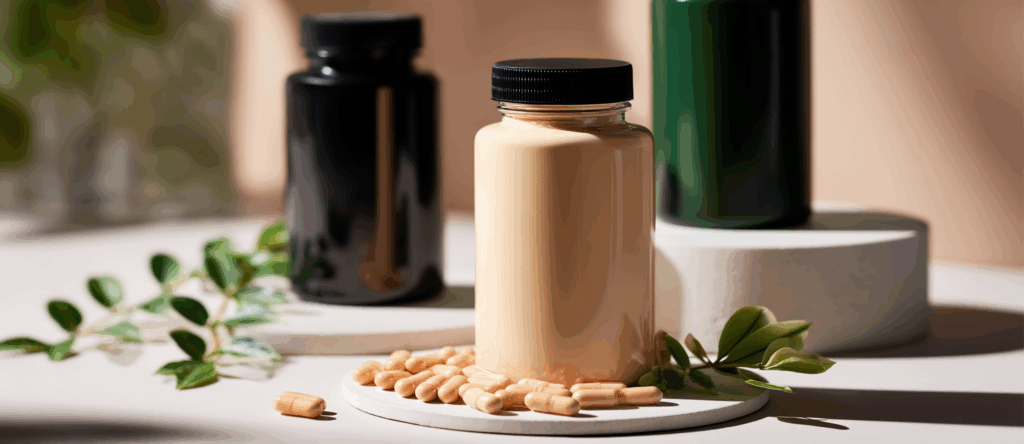
Tablets and capsules are often sensitive to moisture, which can negatively affect their effectiveness, so it’s important to choose suitable packaging. It should provide effective protection against moisture and light – airtight and opaque containers are ideal, such as brown glass bottles or opaque plastic containers. Practicality in dosing is also key – bottles with dispensers or blister packs with easy opening make accurate use simpler.
If the products are intended for active customers, it’s advisable to choose smaller, easy-to-carry packages that fit conveniently in a bag or backpack. Typical packaging for tablets and capsules includes plastic or glass bottles, blisters, or resealable jars.
2. Powder supplements
Powder supplements, such as proteins or superfoods, are usually packed in larger containers, which places specific demands on their quality and construction. The packaging should be strong and stable enough to prevent damage during transport and protect the contents from degradation. To maintain freshness and convenience, it’s important to have a quality closure system, such as a zipper or screw cap.
Since powders easily absorb moisture, the packaging should be waterproof and ideally equipped with an inner protective layer, such as aluminum foil. It’s also important to consider ergonomics – the container should be designed for easy scooping without unnecessary spilling. Typical packaging for this form includes large plastic jars or zip-lock pouches.
3. Drops and tinctures
Drops and tinctures belong to liquid forms of dietary supplements that require particularly careful packaging choices. Glass bottles with droppers are most commonly used, offering several advantages. Glass is an ideal material because it protects the contents not only from light but also from potential chemical reactions that could occur if plastic were used.
The dropper is an essential part of the packaging, as it enables precise and convenient dosing – crucial for liquid supplements. A high-quality package should also include a child-resistant or safety cap, which protects the product from tampering and helps maintain its quality and stability.
4. Bars and chewable tablets
Bars and chewable tablets are a popular form of dietary supplements, especially among younger customers and people on the go. Packaging for these products should meet specific requirements for hygiene, practicality, and attractiveness. Each bar or chewable tablet should be individually wrapped to preserve freshness and prevent contamination during handling.
The packaging should be easy to open, allowing the product to be conveniently consumed anytime, anywhere – ideally without additional tools. The visual appeal of the packaging also plays a major role, as appearance often determines whether the customer chooses the product – especially among younger consumers. Typical packaging includes foil wrappers or small boxes.
5. Liquid capsules and gels
Liquid capsules and gels represent a specific category of dietary supplements that require well-thought-out packaging in terms of protection, usability, and storage. These products are often sensitive to pressure, as the capsules can be fragile and prone to bursting. Therefore, it’s essential to choose strong and durable packaging that reliably protects the capsules from compression or other mechanical damage.
For liquid forms, simple and accurate dosing is also important, which can be achieved with bottles equipped with a measuring cup or a special applicator. Some types of gels and capsules also require refrigeration, which should be taken into account when selecting the appropriate material and packaging design – for example, in terms of thermal insulation and impermeability. Typical packaging includes plastic bottles or blister packs that combine practicality with content protection.
Packaging as the key to protection and trust
Choosing the right packaging for dietary supplements is not just about how it looks on the shelf or online. The key is product quality protection, user convenience, and the ability to communicate effectively with the customer through design.
If you thoroughly understand your products, their specific characteristics, and the needs of your target audience, you can choose packaging that not only protects the content but also builds trust and supports long-term customer loyalty.